
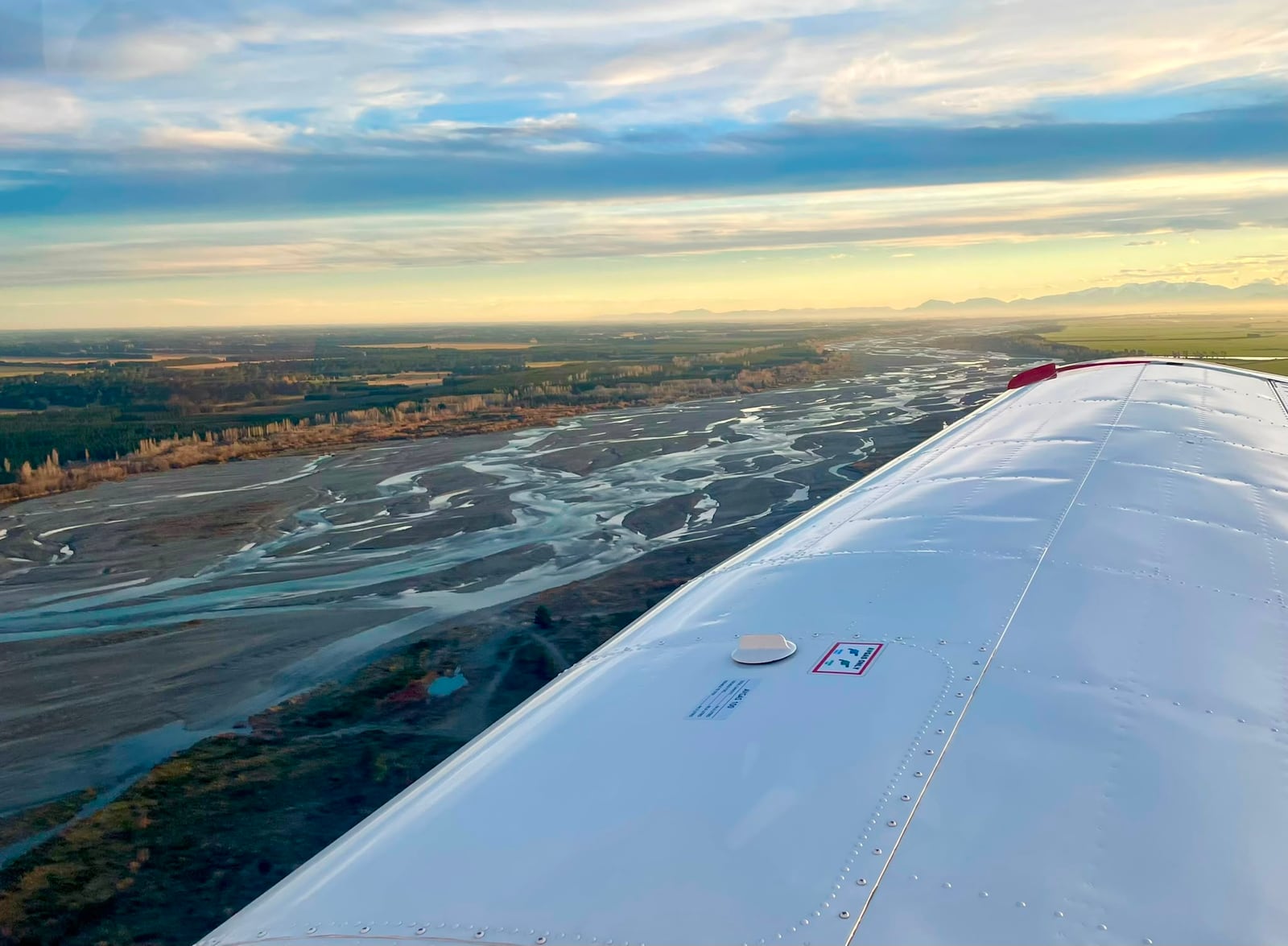
Learning to fly involves taking in a lot of information.
There are procedures to remember, radio calls to make, rules to understand, checks to complete and decisions to make — often while also trying to fly an aircraft accurately.
Then your lesson ends.
You might not be back in the aircraft for another three or four days. Weather, aircraft availability and everyday life can sometimes stretch that gap even further.
So how do you stop everything you learned from fading before your next flight?
The answer probably isn’t another three-hour study session.
A better approach is often much smaller: practise a little, regularly, and make yourself retrieve what you’ve learned.
That idea is at the heart of Aviate.
Your brain needs more than exposure
It’s easy to mistake recognising something for knowing it.
You read a page in your textbook and it all seems familiar. You watch your instructor demonstrate a procedure and it makes perfect sense. You look over your notes and think, yes, I remember this.
But then someone asks you to explain it without the notes in front of you.
Suddenly, it’s much harder.
One useful way to think about learning is to separate working memory from long-term memory.
Working memory is the small amount of information you can actively hold and think about right now. When you’re learning something new, this is where you’re trying to make sense of it.
Long-term memory is where knowledge can be stored for much longer.
For a student pilot, that’s where you ultimately want things such as radio phraseology, airspace rules, checks and procedures to live. You don’t want to rebuild them from scratch every time you need them.
But storing information is only part of the problem.
You also need to be able to find it again.
Think of memory like a track through long grass
Imagine walking across a field of long grass.
The first time you take a particular route, the path is difficult to see. You have to push through the grass and work out where you’re going.
Walk the same route again tomorrow and it becomes a little clearer.
Keep using it and eventually you have an obvious track.
Memory can be thought of in a similar way.
Each time you deliberately try to recall something, you’re practising the route back to that information.
At first, recalling the details of an unattended aerodrome call might take real effort.
Who am I calling? What is my callsign? Where am I? What do I need to say next?
After repeated practice, the route becomes easier to find.
That effort is useful.
In fact, simply rereading the correct answer isn’t the same as trying to retrieve it yourself. When you close the book, think about the problem and make yourself produce an answer, you’re practising the skill you’ll eventually need in the aircraft: accessing knowledge when it isn’t sitting in front of you.
Why one big study session isn’t always the answer
Imagine you have a flight on Saturday and decide to spend three hours studying on Friday night.
You may cover a huge amount of material. By the end of the evening, much of it may feel familiar.
But familiarity immediately after studying doesn’t necessarily mean you’ll be able to retrieve that information when you need it later.
An alternative is to spread some of that study across the week.
Perhaps you spend ten minutes on Monday, five minutes on Tuesday, ten minutes on Thursday and another few minutes before your lesson.
Each session forces your brain to return to the subject after some time away.
The track through the grass has started to grow over — and you walk down it again.
This is the basic idea behind spaced practice.
Rather than trying to learn everything in one sitting, you return to material repeatedly over time.
For aviation training, that can be particularly useful because your flying itself is usually spaced. Regular study gives you a way to keep interacting with the material between flights.
Start by trying to remember
One of the simplest changes you can make is to test yourself before looking at your notes.
Let’s say your last lesson included joining an unattended aerodrome.
Instead of opening your notes and immediately reading the sequence, stop first.
Ask yourself:
What do I remember?
You might write the sequence down, say it aloud or mentally work through the scenario.
Only then check your notes.
If you forgot something, that’s not a wasted attempt. You’ve identified exactly what needs more work.
The same technique works for almost anything:
- What information should be included in this radio call?
- What does this airspace rule require?
- What would I do next in this scenario?
- Why does this aerodynamic effect occur?
- What are the next items in this check?
- What would I say if ATC gave me this instruction?
The important part is that your brain has to produce an answer rather than simply recognise one.
Make the sessions small enough to actually happen
A study plan is only useful if you can stick to it.
Telling yourself you’ll complete two hours of aviation study every evening may sound productive, but for most people it won’t survive contact with work, family, exercise, dinner and everything else happening during the week.
Five or ten minutes is much harder to make excuses about.
You might attach it to something you already do:
Morning coffee: complete a short lesson.
Lunch break: answer five questions.
On the bus: revise yesterday’s topic.
Before bed: mentally work through one radio scenario.
The evening before flying: review the main points from your previous lesson.
None of those sessions feels particularly impressive on its own.
That’s the point.
Learning doesn’t have to feel dramatic to be effective.
Twenty small study sessions that actually happen are worth far more than the enormous study session you keep meaning to do.
Connect your study to your flying
Theory becomes much more useful when it has context.
Instead of only memorising an abstract rule, try putting yourself into a situation where you would need it.
Rather than:
“What information is required in a position report?”
try:
“You’re approaching the aerodrome from the south at 1,500 feet. What would you say?”
Now you’re not simply remembering a list. You’re applying the knowledge.
After a flight, you can do the same thing in reverse.
Think back through the lesson and ask:
- What did my instructor correct today?
- What did I hesitate over?
- Was there a radio call I wasn’t confident making?
- Was there a rule or procedure I understood on the ground but struggled to apply in the aircraft?
- What is one thing I want to be better at before my next flight?
That gives your study a purpose.
Keep one question for your instructor
Independent study shouldn’t mean trying to replace your instructor.
It should help you get more from the time you have with them.
When something doesn’t make sense, write it down.
Your goal isn’t necessarily to solve every uncertainty yourself. Sometimes the most valuable result of a ten-minute study session is discovering the exact question you need to ask.
Instead of arriving at your next lesson thinking I didn’t really understand something from last time, you can ask:
“When we joined yesterday, why did we make that call at that point rather than waiting until we were closer?”
That’s a much easier question for an instructor to work with.
Don’t only practise the things you’re good at
There’s another trap in studying: we naturally gravitate towards things that feel comfortable.
Getting ten questions right feels good.
Struggling through three questions on a topic you find difficult feels much less satisfying.
But the difficult material is often where the useful learning is happening.
If you keep confusing two airspace rules, that’s a signal to revisit them.
If constructing a radio transmission takes too long, practise constructing radio transmissions.
If you’re consistently getting a particular type of question wrong, don’t just move on once you’ve seen the answer.
Come back to it tomorrow.
Then come back again a few days later.
Keep walking down that path.
A simple routine between flying lessons
You don’t need a complicated study timetable.
If your next flight is several days away, something as simple as this can work well:
After your flight: Write down one or two things you want to improve.
The next day: Spend five or ten minutes recalling the key ideas from the lesson.
A couple of days later: Answer some questions or work through a scenario without notes.
Before your next flight: Briefly revisit the areas you struggled with and take any remaining questions to your instructor.
That’s enough to keep the connection alive.
And if you have more time and want to study further, great. The important thing is that the small amount happens consistently.
This is why Aviate uses short lessons
Aviate was built around this idea.
We’re not trying to recreate a traditional ground-school lesson on your phone.
Instead, Aviate breaks aviation subjects into short pieces that you can return to regularly.
A Daily Flight might take only a few minutes. Questions ask you to retrieve material you’ve previously learned. Scenario-based exercises encourage you to apply knowledge rather than simply read it. Flight Radio exercises let you practise deciding what you would actually say before hearing an example.
The intention is to create lots of little opportunities to walk back down those memory pathways.
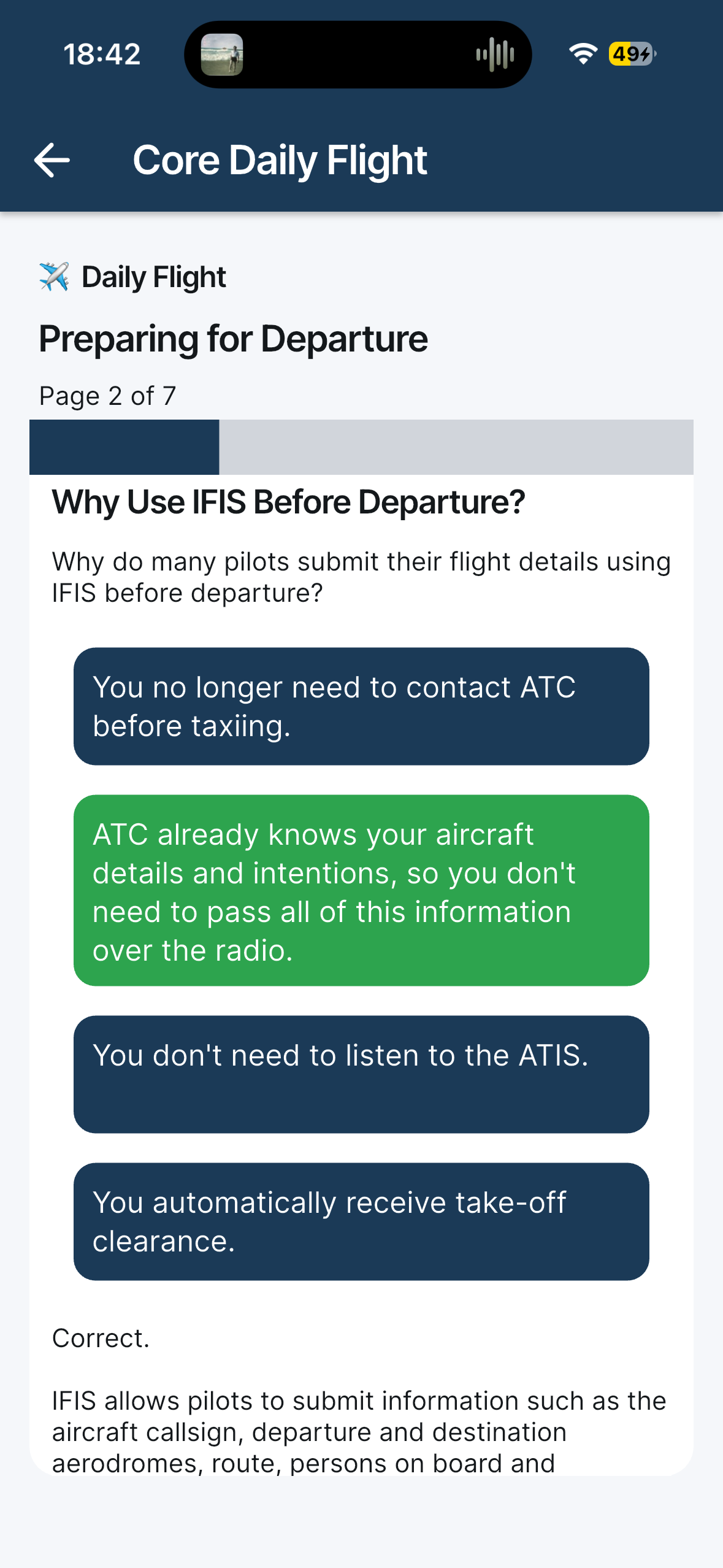
A few minutes today.
Another few minutes tomorrow.
Then again later in the week.
Over time, knowledge that once took significant effort to retrieve should become easier to access.
That’s particularly important in aviation, because ultimately the goal isn’t to remember something while looking at a page in a textbook.
It’s to be able to use what you’ve learned when you’re sitting in an aircraft.
Try it this week
After your next flying lesson, don’t set yourself the goal of doing more study.
Make it more specific.
Choose one thing from the flight that you want to remember.
The next day, before opening your notes, try to explain it from memory.
A couple of days later, retrieve it again.
Then use it in a question, scenario or conversation with your instructor.
The sessions can be short.
What matters is that you keep returning.
Because when it comes to learning, one enormous effort isn’t always as useful as repeatedly finding the path.
Learn a little today. Fly with confidence.
Keep learning with Aviate
Aviate is designed to complement your flight training, ground school and instructor — not replace them.
If you’re studying for your New Zealand PPL, you can explore the Air Law and Flight Radio topics in Aviate, with short lessons, practice questions and aviation scenarios designed to make regular study easier to fit around your flying.
Always use current New Zealand CAA publications, your training organisation’s procedures and your instructor’s guidance as the authoritative sources for your flight training.